Chernobyl Disaster Cleanup Operation
Voices from ChernobylThe Chernobyl Disaster Cleanup Operation was a large, hazardous campaign to contain radioactive contamination at the reactor and across the evacuated area. In the accounts collected in the book, it appears not as a single technical feat but as a collision between emergency labor, military obedience, disrupted village life, and the attempt to control an invisible danger. Workers shoveled radioactive debris and soil, mapped exposure, flew over the damaged reactor, and excavated beneath it; residents watched their homes and harvests become forbidden or disposable. The operation’s scale and its human cost emerge together, in work routines that could seem both heroic and brutally absurd.
Mobilization and Conditions
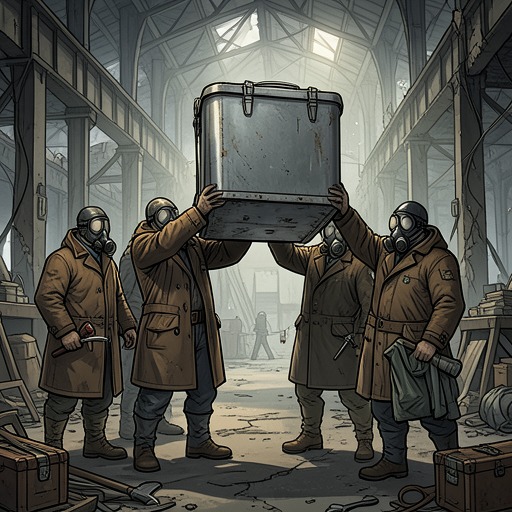
The cleanup drew on people with sharply different skills, but assignments often reduced specialized workers to improvised instruments. One chemical engineer, who had a master’s degree and headed a laboratory, was handed a shovel; his unit joked, “Fight the atom with a shovel!” Respirators and gas masks were issued, but in heat of 30 degrees Celsius workers generally did not wear them. Transport and accommodation were crowded: one account describes seventy men sharing a train car with forty-five seats, then ten men to a tent. The work took place amid military hardware, wash posts, and empty villages, while workers’ families remained at home, some with pregnant wives or young children.
The everyday arrangements could expose workers to danger even outside their assigned tasks. After two months, dosimetrists discovered that one unit’s cafeteria stood in a place with higher radiation than the work site. It consisted of boards nailed to posts, where the men ate standing up; they washed from barrels, used a long pit in an open field, and worked with the reactor nearby. Only after two months did the men begin to insist that the assignment was not a suicide mission and that another shift should replace them. A major-general told them that bringing in new men would be expensive and complicated because the existing workers were used to the place and had already received three sets of clothing. Certificates of merit for particularly effective digging turned the work into a grim performance of recognition even as its duration and risks remained at issue.
Work at the Reactor and Below It
On the reactor roof, soldiers gathered fuel, graphite, concrete, and metal fragments from the ruined structure. The work was done at extreme speed: one account says it took about twenty to thirty seconds to fill a wheelbarrow and another thirty seconds to throw the load off the roof. The special wheelbarrows weighed forty kilograms before anything was added. Lead vests and masks offered little protection from radiation coming from below, and the workers’ brief daily turns on the roof did not make the exposure trivial. Three thousand six hundred soldiers worked there. Radio-controlled machines repeatedly failed or acted against their commands when radiation disrupted their electronics, leaving soldiers as the more dependable cleanup force—the so-called green robots.
Other testimony describes a squad sent to the reactor after five months of evacuation work. The men had heard they might have only five, seven, or ten years to live, yet the whole squad stepped forward when volunteers were called. Their instructions allowed forty or fifty seconds on the roof, but loading a wheelbarrow, reaching the work area, and throwing debris down took longer. Dosimeters rated for five and two hundred roentgen reached their limits. Official claims that the air around the reactor was clean became a bitter joke among the men, who knew they had received serious doses.
The work also extended below the reactor. Four hundred miners labored around the clock to blast a tunnel so liquid nitrogen could be poured in and the earth beneath the reactor frozen, preventing it from reaching groundwater. The account describes miners from Moscow, Kyiv, and Dniepropetrovsk working naked in temperatures of up to fifty degrees Celsius, pushing small cars while crouched on all fours. Their exposure was high, and the speaker later described them as heroes of a war that was officially called an accident or catastrophe. In a separate emergency, volunteers were sought to open a safety-valve bolt and drain water from beneath the reactor, to prevent water mixing with uranium and graphite from forming a critical mass. The feared explosion was estimated at three to five megatons, with the potential to make Kyiv, Minsk, and a large part of Europe uninhabitable. The volunteers opened the bolt; the promised cars and apartments did not follow, and the men were remembered in the speaker’s account through the documents bearing their names.
Mapping, Flight, and the Scale of Exposure
The cleanup depended on workers who measured hazards directly. Colonel Yaroshuk, a chemist and dosimetrist, walked from the reactor through the surrounding sectors with a dosimeter, tracing the boundaries of high-radiation spots so that he could mark them accurately on a map. The account describes him as once strong and now paralyzed, with his wife turning him and feeding him by spoon. He needed an operation for kidney stones, but his family could not afford it. His story joins the practical labor of mapping contamination to the later vulnerability of the person who had been sent to locate it.
Helicopter crews carried out another form of dangerous work. Colonel Vodolazhsky stayed after receiving more than the allowable radiation dose and trained thirty-three additional crews. He made 120 flights, releasing 230 tons of cargo, with an average of four or five flights a day. Pilots flew about 300 meters above the reactor in cabins that reached 60 degrees Celsius; to aim at the fiery crater, they leaned out and judged the target with the naked eye. The reported activity reached 1,800 roentgen per hour, and pilots began to feel its effects while still in the air. Vodolazhsky’s radiation card recorded seven becquerels, while the speaker said the actual amount was six hundred.
The scale extended far beyond the most visible jobs. One account estimates that 210 military units, amounting to about 340,000 military personnel, were thrown into the liquidation of the fallout. At government commission meetings, the sacrifice of lives was discussed in routine terms: “We’ll need to put down two to three lives for this. And for this, one life.” That matter-of-fact language stands beside accounts of young workers who understood their service through a culture of great collective achievement, even as they faced death, injury, and promises that might never be kept.
Villages, Animals, and Contaminated Ground
Cleanup did not stop at the reactor. Workers dug up diseased topsoil, loaded it onto trucks, and carried it to what they had expected to be engineered waste sites, only to find ordinary pits. They rolled up entire layers of earth, including grass, flowers, roots, insects, spiders, and worms. The work left long stretches of torn-up, fallow land, while houses, barns, trees, roads, kindergartens, and wells remained exposed. Some roofs were replaced and slate changed even when the workers understood that such repairs were useless; they returned to dig again after wind had deposited new sand. A polymer film sprayed by helicopter to keep mobile bottomsoil from moving was one measure a worker considered intelligible amid the repeated excavation.
The military presence also enforced the separation of residents from their property. Soldiers manned roadblocks and observation posts to prevent former inhabitants from returning to evacuated villages. Farmers could not retrieve a bucket, pitcher, saw, or axe, or harvest crops. On one side of the road soldiers kept people out; on the other, cows grazed, harvesters worked, and grain was shipped. Workers described the contradiction of watching a woman milk a cow and then making her pour the milk onto the ground, or ensuring that eggs were buried. The land could look beautiful while its produce was treated as poison. For some residents, the forced destruction and burial of what they had grown annulled the labor and meaning of their lives.
Animals were caught between evacuation rules and human attachment. In one abandoned house, a worker found a real cat on the windowsill, among eaten geraniums, and remembered notes asking visitors not to harm cats left behind. In another hut, a soldier told an old woman that she could not take her cat because its fur was radioactive; she refused to leave without the animal, calling it her family. A boy who later saw films about Chernobyl asked why nobody had helped the animals, a question the filmmaker could not answer. The operation’s boundary of concern thus becomes visible not only in what was removed or buried, but in the lives that could not be given a place in the evacuation plan.
Secrecy, Aftermath, and Meaning
Workers’ recollections describe a gulf between hazardous service and what followed. One soldier said his unit had signed a non-disclosure form, and that after returning from the army he became a second-group invalid at twenty-two. He recalled carrying buckets of graphite from the reactor with ordinary shovels, changing masks as many as thirty times in a shift, and helping pour the sarcophagus. His unit returned without a change of clothes and remained in the same trousers and boots until demobilization. Later, when he invoked his status as a Chernobyl liquidator at his factory, his director answered that the factory had not sent him there. The work had been demanded in the name of collective duty, but its consequences did not guarantee that institutions would recognize the worker’s claim to care.
The difficulty of documenting service compounded that abandonment. A filming group that had spent six months in the Zone sought benefits for a member who needed an apartment, but the union committee required certificates with official seals. At the regional committee, the speaker found only a woman named Nastya going around with a mop; the people who could provide documentation had left. Another account describes medical documents as hidden or destroyed because they were classified, leaving workers unable to show doctors how much radiation they had received. In this record, the cleanup’s aftermath is not only illness but also a struggle to make hazardous labor legible to systems that demand proof.
The book’s testimony holds together courage and coercion without allowing either to erase the other. Soldiers volunteered for perilous work, miners and pilots continued under severe conditions, and speakers describe a powerful ethic of sacrifice. Yet the same accounts show inadequate protection, exposure records that understated doses, blocked access to homes, and workers left to manage illness and recognition on their own. Calling the operation a war gives its labor the scale of a collective emergency; the ruined soil, displaced residents, abandoned animals, and remembered bodies show what that framing cannot resolve. The cleanup contained some dangers by making people, animals, and landscapes bear others.